

News
On our news pages we report on various topics, including language and translation, and show you important steps in the history of our translation office.
September 2026: European Day of Languages
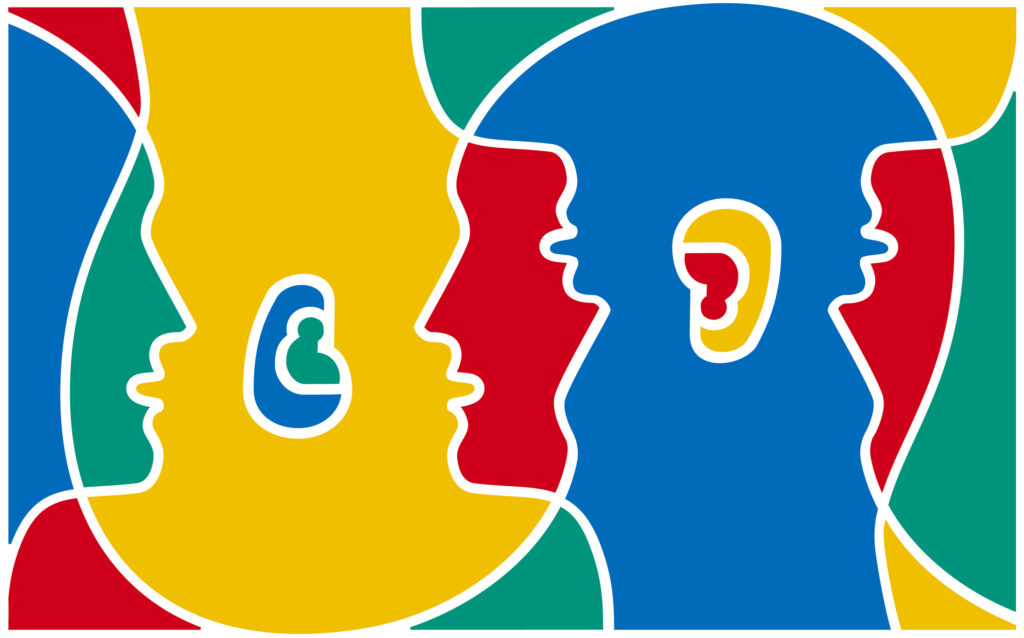
On the initiative of the Council of Europe, the European Day of Languages was held for the first time in 2001, the ‘European Year of Languages’. Since 2002, the day has been celebrated annually on 26 September.
The aim is to preserve the rich heritage of the 200 European languages, to continue promoting individual multilingualism, and to contribute to the appreciation of all languages and cultures.
This initiative wants to encourage around 700 million citizens in the 46 member states of the Council of Europe to discover and learn languages at any age, whether as part of their regular school education or alongside it. In addition, as part of the Day of Action, the Council of Europe, in collaboration with the European Union, supports events, initiatives and activities relating to language learning. These are coordinated by the Council of Europe’s European Centre for Modern Languages (EFSZ/ECML/CELV) in Graz and organised locally in each country together with partner organisations.
The official languages in Europe within the European Union (currently 24 official languages) are as follows
- Since 1957: German, French, Italian and Dutch
- Since 1973: Danish, English, Maltese and Irish
- Since 1981: Greek
- Since 1986: Portuguese and Spanish
- Since 1995: Finnish and Swedish
- Since 2004: Estonian, Latvian, Lithuanian, Polish, Slovak, Slovenian, Czech and Hungarian
- Since 2007: Bulgarian and Romanian
- Since 2013: Croatian
May 28, 2026: International „Easy Language“ Day
Whether it’s reading newspaper articles, understanding election documents, or filling out government forms, studies show that around 14 million people in Germany have difficulty reading and understanding conventional texts. There are many reasons for this: reading difficulties, learning disabilities, mental disabilities or dementia, poor German language skills, and much more.

International Easy Language Day on May 28 (based on the date that the founding documents of Inclusion Europe* were signed in 1988) is a reminder that there is a solution for many people: easy language.
Easy language is not a protected term, but there are various sets of rules (e.g., from the German Society for Easy Language) that describe what it should look like. According to these rules, sentences are short, there are many paragraphs and headings, foreign and technical words are avoided. Each sentence contains only one piece of information. Complicated words and abbreviations are explained. As simple as necessary, as understandable as possible is the motto.
Easy language is helpful for millions of people in Germany who would otherwise often fail due to language barriers. This also applies to everyday situations, such as visits to the doctor, tax returns, or dealing with government agencies. More and more institutions, authorities, and ministries now also offer information in easy language. In our industry, too, there is growing demand for additional services in the field of easy language translations. The BDÜ (Bundesverband der Dolmetscher und Übersetzer), for example, is increasingly offering further training in this area.
*Inclusion Europe is an initiative that fights for equal rights and full inclusion of people with intellectual disabilities and their families in all aspects of society.
Happy Easter!

We wish all our customers and colleagues wonderful Easter holidays,
with time for family and traditions as well as a busy Easter bunny.
Glædelig påske, Buona Pasqua and Frohe Ostern!
Your Schweitzer Sprachendienst Team
March 2026:
International French Language Day

As one of the six working languages of the United Nations (UN), the French language will be celebrated on March 20, 2026. The date was chosen to mark the anniversary of the International Organization of La Francophonie/OIF (an association of over 50 countries where French is the native language or is spoken by a large part of the population).
In 1539, French, which belongs to the Roman languages, all of which originated from the Latin of the Roman occupying power, was established as the official national language.
Enlightenment thinkers and poets of the 17th and 18th centuries strengthened the prestige and influence of the French language, which later became the court language of the European nobility.
The Day of the French Language is intended to promote the equal use of languages and to reflect the cultural and linguistic diversity of the organization. In France, the so-called Loi Toubon has also been in force since August 4, 1994: this law is intended to protect the French language from Anglicisms, for example, and thus to counterbalance the Anglophone world. Parlez-vous français?